Elder Things
The Colour Out of SpaceThe Elder Things are an alien race whose ancient dominion and possible return shape one of the most deeply buried terrors in the account. Described through scattered myths, dreams, and information recovered from captive minds, they once ruled Earth and three other solar planets, were driven into the inner earth by the Great Race of Yith, and remained a feared presence behind sealed passages and a strict taboo on discussion.
Nature and Perception
The account places the Elder Things’ arrival about six hundred million years in the past, when they came through space from immeasurably distant universes. They were only partly material by human standards, and their consciousness and perception differed entirely from those of terrestrial organisms. Sight was not among their senses: their mental world consisted instead of patterns of impressions. Their perceptions could penetrate material barriers, although their own substance could not pass through them.
Despite their unusual materiality, they could use ordinary physical implements in cosmic regions where such matter existed, and they needed shelter of a peculiar kind. They could move through the air without wings or any visible means of levitation. The Great Race could not exchange minds with them, a limit that set them apart from other beings encountered through its powers of mental projection. Certain forms of electrical energy could destroy them, but the account does not describe a final defeat.
Dominion and Subjugation
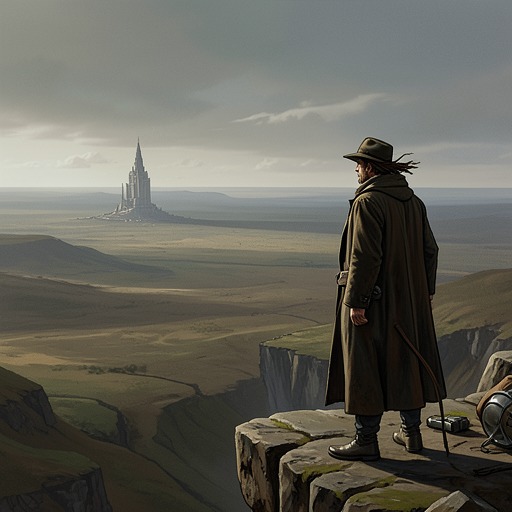
Before the Great Race arrived from Yith, the Elder Things had built immense cities of windowless basalt towers and preyed upon the beings they found. The Great Race, armed with instruments of its own making, proved able to subdue them. It drove them down into caverns of the inner earth, some already connected to the newcomers’ habitations, then sealed the entrances and occupied most of their cities.
The victors did not treat every former stronghold as an ordinary ruin. They preserved certain important buildings for reasons attributed to superstition rather than indifference, audacity, or scholarly interest. That choice left the landscape marked not only by conquest but by unease: the defeated race had been confined, not erased, and its old architecture retained an unexplained hold on those who inherited its cities.
The Sealed Passages and the Predicted Return
Over the aeons, the Great Race received signs that the Elder Things were growing stronger and more numerous in the inner world. At intervals, they broke into remote cities, including abandoned settlements where routes to the depths had not been adequately sealed or guarded. The Great Race responded by closing many passages permanently. It left some sealed trap-doors in place for strategic use in case of further eruptions, while geological changes created new rifts and choked off some older routes.
These incursions left a lasting mark on the Great Race’s collective outlook. The subject became so charged with horror that members of the race did not intentionally discuss it, and relevant material was absent from ordinary records. The surviving hints about the Elder Things’ appearance were indistinct: they suggested monstrous plasticity and temporary invisibility, and associated the beings with control or military use of great winds, strange whistling sounds, and enormous tracks made up of five circular toe-marks. No account supplies a clear image of them.
The most disturbing fragment concerns a future breakthrough. The Great Race’s projections through time had, according to the recovered information, foreseen a final successful irruption. The anticipated assault was understood as vengeance rather than an effort to reclaim the outer world. Knowing that later races would pass across the surface without further interference, the Great Race inferred that the Elder Things might prefer Earth’s dark inner abysses, or might weaken over immense spans of time. They were expected to be dead by the era of the post-human beetle race. Until then, the Great Race maintained armed vigilance even while banishing the subject from common speech and visible records.
Evidence, Memory, and Uncertainty
The Elder Things emerge not from a single direct encounter but from a chain of incomplete testimony. Nathaniel Wingate Peaslee pieces together ancient and modern records, anthropological and medical material, myths, dreams, and impressions associated with the Great Race. The information about the Elder Things comes in scraps, some gleaned from unusually observant captive minds; the silence imposed around the subject is itself part of the account’s evidence, but it also restricts what can be known.
The wider history unsettles ordinary human measures of time. The myths and delusions place humanity among successive dominant races on a planet whose history extends far beyond human memory, while the Elder Things’ cities and the Great Race’s response belong to a much older world. In the Australian desert, excavated blocks evoke an ancient, unknown civilization and a landscape of deep geological time; Peaslee’s discoveries intensify the suggestion that memories and material traces may outlast the cultures that produced them. Yet the evidence does not make every detail of the Elder Things’ history directly verifiable.
Their narrative force rests on this tension between confinement and survival. The Great Race conquered the Elder Things, sealed their routes, and prepared for the possibility that those defenses might fail; its future knowledge offered no assurance that the threat had vanished. At the same time, the projected history placed the Elder Things’ eventual death before the post-human beetle age. The account therefore preserves both a forecast of return and a later limit to their power, without turning the centuries-long vigilance between them into a resolved or witnessed final encounter.